
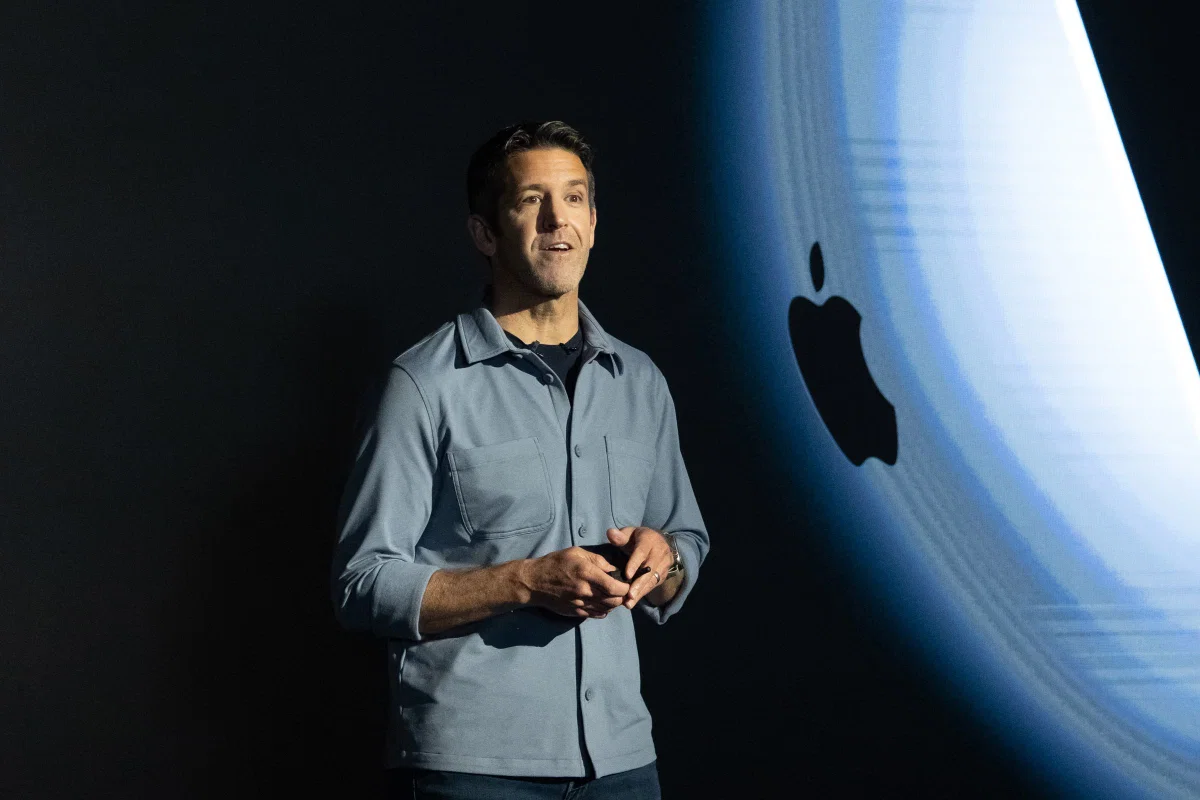
Two months into the job, Apple’s new chief executive has shipped a folding phone, a home hub and the first touchscreen Mac. The harder test, what Apple is for in an age of artificial intelligence, has only just begun.
On the first Monday of November, John Ternus sits down for his first earnings call as chief executive of Apple. Investors will listen for three things: the holiday forecast, what he says about AI and the rebuilt Siri, and how badly rising memory-chip prices are biting. Analysts expect those costs to drag quarterly profit growth to its weakest in six quarters.
It is a fitting first exam for a man who spent a quarter of a century being judged by things you can hold in your hand. Until this year, Ternus rose through Apple’s hardware ranks while keeping an almost invisible public profile. The question worth asking is not whether he can run the company. It is whether an engineer’s Apple will look, and feel, different from the operator’s Apple that came before it.
Ternus was born in California in May 1975. He met his first Apple product at eight, when his father brought home an Apple II and the boy started playing games on it. He went on to study mechanical engineering at the University of Pennsylvania, where he was also a competitive swimmer. His first job out of college was at Virtual Research Systems, a small maker of virtual-reality headsets. There is a quiet symmetry in that: the young engineer who began in VR would, two decades later, oversee the team that built Apple Vision Pro.
He joined Apple’s product design team in 2001, and his first assignment was scrutinising parts for the Apple Cinema Display. He became vice president of hardware engineering in 2013 and joined the executive team in 2021. On his watch the Mac left Intel for Apple’s own silicon, and his teams built the iPhone, iPad, Apple Watch and AirPods. By the time the succession was announced, he already controlled development of products bringing in roughly 80 percent of Apple’s revenue. As the longtime Apple chronicler Leander Kahney put it, Ternus has a deep, deep expertise in how to make things.
Apple has had only three chief executives this century, and each has embodied a different idea of the company. Steve Jobs was the visionary. Tim Cook, who took over in 2011, was the operator: under him Apple’s market value climbed from $348 billion to more than $4 trillion, and its services grew into a $100 billion business. When Apple announced the succession on 20 April, Cook described his heir as having “the mind of an engineer, the soul of an innovator.” Ternus took over on 1 September at 50, the same age Cook was when he succeeded Jobs. Cook stayed on as executive chairman, with a brief that includes dealing with governments around the world.
The more telling change is how Ternus spends his days. According to Bloomberg, he leaves finance and the supply chain largely to others, and gives his own hours to product engineering with chief hardware officer Johny Srouji and to the design studio. Apple has had no single leader over both industrial and software design since Jony Ive left in 2019. Ternus is now filling that role himself, rebuilding a studio thinned by departures, including software design head Alan Dye’s move to Meta in late 2025. One of his first hires was the Belgian furniture designer Julien Renault. The centre of gravity, in other words, has moved from the spreadsheet back to the studio.
In seven weeks this autumn, Ternus’s Apple staged three launches, each opening a door the old Apple had kept shut. The first, on 9 September, was the iPhone Duo, Apple’s first foldable. It opens to a 7.6-inch screen and starts at $1,999. Analysts had expected $2,500, and Samsung’s top folding phone sells for $2,099: Apple arrived last and priced below the incumbent. Ternus himself is named on the original patent behind its technology, filed some 15 years ago. Asked by TIME why Apple waited so long, he was blunt: earlier folding phones from rivals felt “kind of cheap and crappy.”
The second launch, on 13 October in New York, was about the home. Apple unveiled HomeView, a $299 hub with a screen, alongside a new HomePod mini and Apple TV 4K. The third, on 28 October in Los Angeles, brought the first MacBook Pro with a touchscreen and an OLED display. For years Apple insisted that fingers did not belong on a Mac screen.
None of these is a new category for the world. Folding phones, smart displays and touch laptops have all existed for years. Apple’s old genius was never to arrive first, but to arrive finished, as the Watch and AirPods did. The open question is appetite. In a YouGov survey for CNET, 75 percent of American adults said they had no interest in a folding Apple device, and respondents put the price they would pay at about $781, less than half of what Apple charges.
The objects, though, are the easy part. Forrester analyst Thomas Husson framed the real task for any new Apple chief: to crack AI as the new user interface. Rivals are betting that AI-first products can loosen Apple’s grip on consumer electronics. Apple’s answer so far is pragmatic. The new Siri runs on Google’s Gemini models, under a deal reported at around $1 billion a year, and brings a standalone app, actions across apps and awareness of what is on screen.
Ternus refuses to apologise for the pace. Speaking to WIRED’s Steven Levy, he said Apple will lean heavily on AI but added: “We don’t want to ship AI for AI’s sake.” When Levy raised the prospect of AI agents making apps unnecessary, Ternus answered that making products remains a deeply human act. To TIME, he put his wager more simply: “People want physical things.”
His bet is that AI will become like the chip inside the phone: indispensable, but invisible, with the object still the point. The risk is the reverse. If the main way we use technology becomes conversation, the beauty of the object may matter less than the intelligence behind it, and that intelligence, for now, is partly rented from Google.
The new Apple is also a more expensive one. A global memory-chip shortage helped push the iPhone 18 Pro up by about $100 on its predecessor. Bloomberg reports that Ternus is planning small-scale layoffs within large teams and cancelling projects, hoping to avoid bigger price rises in 2027 if the shortage persists. This is the Ternus method in miniature. He told TIME that Apple cannot do everything, so it narrows its focus to what matters most and pours its effort there. Fewer projects, fewer people, better objects: it is an engineer’s idea of discipline rather than an accountant’s.
The pressures beyond his control are just as real. Apple still depends heavily on China to manufacture its products, and analysts say it must decide how far to keep that reliance, precisely the kind of geopolitics Cook, as chairman, has been asked to keep handling. Meanwhile the market has given Ternus room: Apple is valued at roughly $5 trillion.
Why should a magazine of culture care who runs a technology company? Because for two decades Apple has shaped not just what we use, but what we consider beautiful, well made and worth owning. Its objects are among the most widely shared pieces of design on earth, from a studio in Jakarta to a warung counter in Bali. An engineer who spends several days a week in the design studio and hires a furniture designer is making a cultural argument. He is saying that in an age of invisible software, the made thing still matters: its weight, its hinge, the way it closes.
The first quarterly numbers will measure his opening months. The real measure will come later, and it will not be a balance sheet. It is whether, five years from now, there is an Apple object we cannot imagine living without that we have not yet seen. Jobs gave us the iPhone. Cook gave us an empire. Ternus has to decide what comes after the screen.



Leave a Reply